Can High-Tech Greenhouses Drive the Future of Sustainable Horticulture?
Insights on vertical farming - March 11th 2026
Key Takeaways
- High-tech greenhouses combine natural sunlight with precision climate control, offering a balanced alternative to fully indoor farming.
- Precision irrigation and water reclamation systems can significantly reduce water use while improving crop consistency.
- Hybrid greenhouse models leveraging natural sunlight lower energy demand while maintaining tight control over lighting and climate conditions.
- High-density mobile grow systems maximize productive area by eliminating fixed aisles and optimizing cubic space.
- Automation and sensor-driven greenhouse technologies enable more precise crop management while reducing resource waste.
- Infrastructure design plays a critical role in sustainable horticulture, influencing yield, operating costs, and long-term scalability.
By integrating sustainable innovations such as vertical farming strategies and high‑density mobile grow racks into high‑tech commercial greenhouses, operators can capture the precision of controlled environment agriculture (CEA) without replicating the environmental footprint of conventional production. In markets from North America to Europe and the Middle East, these hybrid facilities are enabling growers to boost yields, control risk, and make better use of every cubic foot of space.
Conserving Resources in High-Tech Greenhouses
Fully indoor facilities offer a sealed environment, but they also lock operators into very high energy costs. Modern commercial greenhouses occupy a middle ground. Their semi‑permeable nature demands more sophisticated water and climate management, yet continuous advances in sensing, controls, and infrastructure mean they can still deliver the resource efficiency for which CEA is known.
For operators, the question is not “greenhouse or indoor,” but how to design a greenhouse system that aligns with local climate, energy pricing, and long‑term operating strategy. When that system is built around precision irrigation, water reclamation, and intelligent infrastructure, greenhouses can meet sustainability targets while still hitting the yield and quality metrics investors expect.
Precision Irrigation and Water Reclamation
In high‑tech greenhouses, irrigation is engineered rather than estimated. The most effective systems deliver water and nutrients directly to the root zone, monitor moisture levels in real time, and adjust delivery to avoid both drought stress and overwatering—two major drivers of disease and crop loss. By closing the loop with reclamation technology, growers can safely recapture nutrient‑rich runoff and reuse it instead of discharging it as waste.
One study of the U.S. ornamental industry projected that if just half the sector adopted precision irrigation and achieved a 50% reduction in water use, the impact would be substantial. The resulting savings could supply water to roughly 400,000 households annually, reduce energy consumption equivalent to removing 7,500 cars from the road, and prevent hundreds of thousands of pounds of nitrogen and phosphorus from entering the environment.
The Hybrid Solar Approach
Indoor CEA facilities depend on advanced LED “light recipes” to maintain year‑round production. In regions with high electricity prices or carbon‑intensive grids, this dependence quickly becomes a constraint on scale. That is why many operators are adopting hybrid greenhouse models that combine precision controls with natural sunlight and, where possible, on‑site renewable energy.
High‑tech greenhouses allow growers to leverage free solar radiation, reducing lighting hours and total energy demand while still maintaining tight control over photoperiod, spectrum, and climate. This approach can materially reduce both operating expenses and the carbon footprint of production, while also lowering the upfront capital required for lighting in a fully indoor facility. For facilities in markets such as Canada, Northern Europe, or the Middle East, a hybrid greenhouse often represents the most realistic path to year‑round production at competitive unit economics.
Eliminating Waste Through Smart Technology
Combating water loss through transpiration and evaporation is a constant battle in greenhouse management. New greenhouse technologies are helping operators reduce both water loss and climate control costs. Superabsorbent substrates—engineered polymers or biodegradable alternatives—can retain hundreds of times their weight in water, releasing moisture gradually as crops demand it.
Furthermore, heat management is becoming more sustainable through radiative cooling. This technology reduces the need for water-intensive evaporative cooling and energy-heavy HVAC systems. Some systems even incorporate atmospheric water harvesting, converting greenhouse humidity into a sustainable source of pure water. This holistic, closed-loop thinking represents the future of sustainable infrastructure.
Maximizing Space with Mobile Benches
In any commercial greenhouse, the racking and benching system is the backbone of profitability. Static shelving and traditional rolling benches leave too much revenue on the table because they lock in fixed aisles and underutilized cubic space. To realize the full potential of a high‑tech greenhouse, the storage and grow infrastructure must be as agile and dense as the production plan.
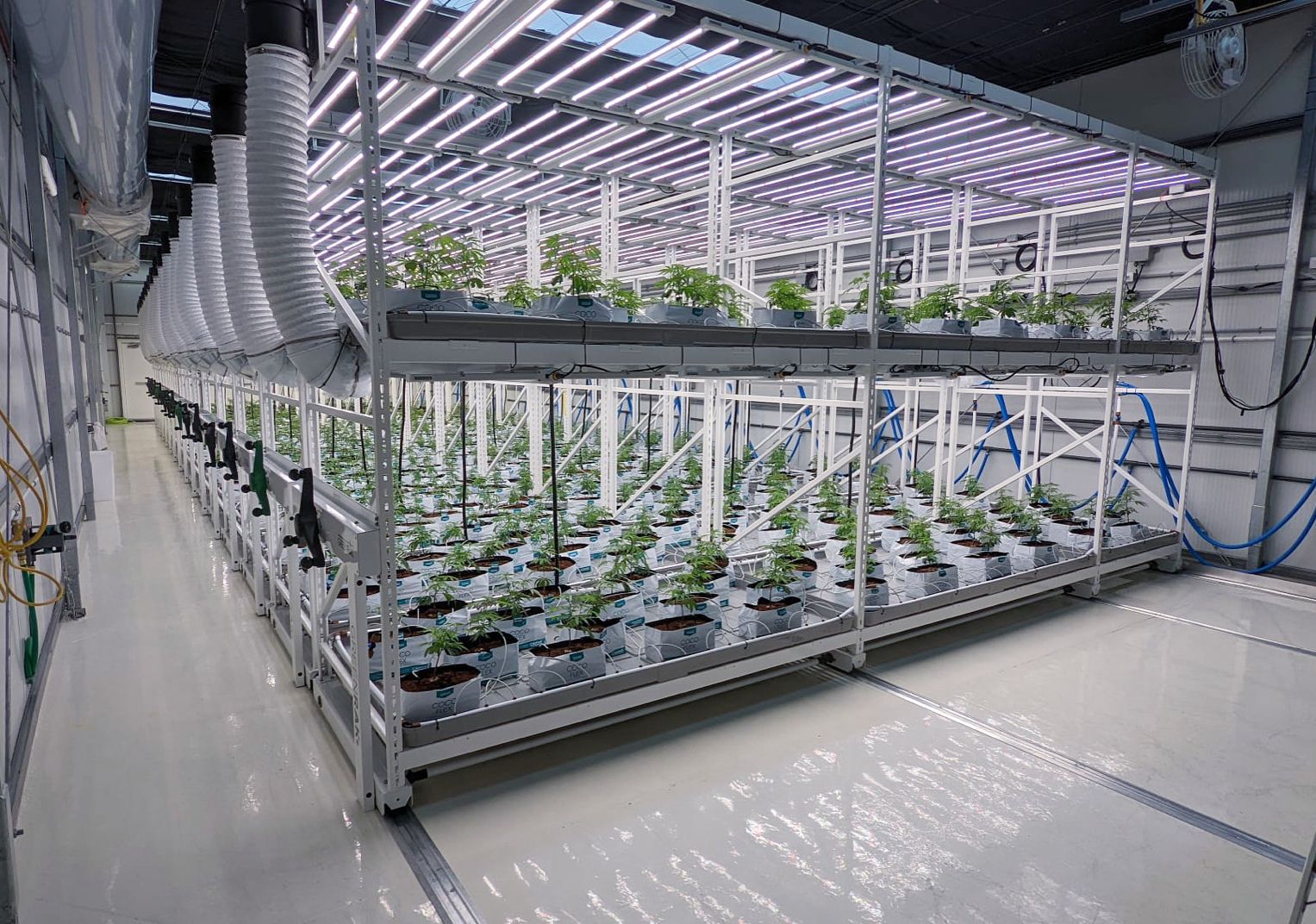
Montel’s GREENRAK® 2.0 systems are designed with that reality in mind. By eliminating all but one active working aisle at a time, a principle proven in vertical farming, these systems can double the productive area within the same footprint. In competitive markets like the Middle East and Europe, this level of spatial efficiency can be the difference between a viable project and a stranded asset.
Beyond density, modern mobile benches are engineered for day‑to‑day operations. Features such as ergonomic working heights, SafeCrank mechanical assists, low‑profile tracks, and sloped trays for drainage are designed to improve worker safety, streamline sanitation, and reduce standing water. For operators scaling from a first facility to a multi‑site portfolio, those details compound into measurable gains in throughput, labor efficiency, and audit‑readiness.
Q&A
Q: What is the primary environmental drawback of traditional agriculture?
A: Traditional agriculture uses excessive land (44% of the world's arable land), wastes significant amounts of water, and pollutes the soil and groundwater with millions of tons of fertilizer and pesticide.
Q: How do high-tech commercial greenhouses contribute to water conservation?
A: They utilize precision irrigation systems for targeted root delivery, incorporate water reclamation technology for safe reuse of nutrient-rich water, employ radiative cooling to reduce evaporative cooling needs, and use superabsorbent substrates to retain and efficiently release water to plants.
Q: What is the main advantage of a hybrid greenhouse CEA model over purely indoor farming?
A: The hybrid model allows farms to capitalize on natural sunlight, minimizing the high energy costs and massive upfront investment associated with purely artificial lighting in indoor CEA facilities, while still providing the control benefits of precision agriculture.
Q: How do mobile benches, like GREENRAK 2.0, optimize space in a commercial greenhouse?
A: They are a core component of high-density mobile storage systems that maximize yield per square foot by eliminating all but one working aisle at a time, allowing growers to significantly increase the productive area within the existing greenhouse footprint.
Q: Which regions and markets are particularly relevant for adopting sustainable greenhouse technology?
A: Key markets and regions include North America (USA, Canada), Europe, and the Middle East, where water scarcity, energy costs, and the need for localized food security drive the demand for sustainable greenhouse technology and precision agriculture.