Montel Helps Advance the Future of Pollinator-Independent Indoor Berry Production
Insights on vertical farming - February 5th 2026

Why Pollination Changes Everything Indoors
Indoor farming has made significant progress over the past decade. Leafy greens and herbs have scaled successfully in controlled environments. Berries, however, remain one of the industry’s most complex and unresolved challenges.
At the heart of that challenge is pollination.
In traditional agriculture, pollination is supported by natural ecosystems. In indoor, multi-layer vertical farms, those conditions do not exist. Bees are difficult to manage in enclosed environments, airflow is constrained, lighting is artificial, and spatial density fundamentally alters plant behavior. Across the industry, this has made indoor berry production expensive, inconsistent, and difficult to scale with confidence.
Understanding the Industry Challenge
Globally, the controlled-environment agriculture (CEA) sector has tested multiple approaches to indoor berry pollination — from manual intervention to mechanical vibration and partial pollinator introduction. While some methods have shown promise at small scale, none have delivered the reliability, repeatability, and operational efficiency required for long-term commercial viability.
The conclusion is increasingly clear across the industry: indoor berries require a pollination solution designed specifically for controlled environments — not an adaptation of outdoor methods.
This is precisely where scientific research becomes essential.
The Innovation Led by TMU
Researchers at Toronto Metropolitan University (TMU), led by Professor Habiba Bougherara and Professor Lesley Campbell, are advancing a patented pollination system that addresses this challenge at its root.
Their work applies airflow dynamics and microclimate control to autonomously transfer pollen between flowers — enabling raspberries, and potentially other berries, to be grown indoors without bees. Rather than relying on biological workarounds, the system is engineered to operate within the physical realities of indoor, multi-layer growing environments.
In June 2025, the TMU research team was awarded up to $5 million in funding to accelerate this work, with major support from the Weston Family Foundation through the Homegrown Innovation Challenge. The investment reflects both the scientific rigor of the research and its potential to unlock a long-standing barrier in indoor food production.
“This funding allows us to build and test a system that could transform indoor berry production in Canada. Partnering with Montel gives us the ability to validate our technology under real indoor growing conditions.” — Professor Habiba Bougherara, Toronto Metropolitan University
Montel’s Role: From Theory to Reality
At Montel, we have spent years engineering systems that perform under real-world constraints — space, airflow, load, efficiency, and durability. We understand that innovation in indoor farming does not succeed in isolation; it must be tested, measured, and proven within operational environments.
That understanding is why Montel joined this initiative.
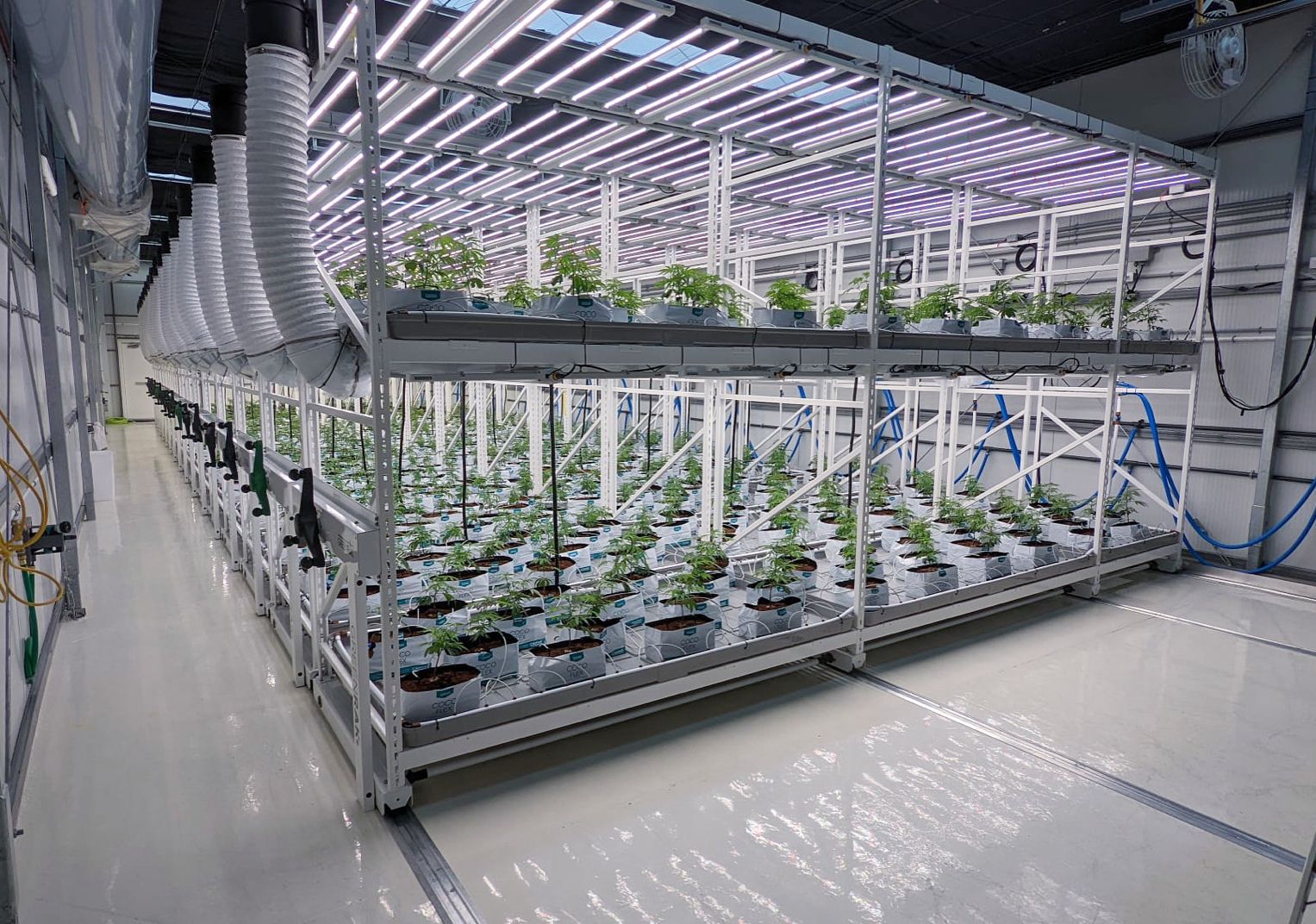
To support TMU’s scientific leadership, Montel designed and now hosts MoFarm, a purpose-built pilot farm located adjacent to its manufacturing facility in Montmagny, Québec. Conceived as a multi-level indoor microclimate farm, MoFarm is built on Montel GreenRak™ multi-tier grow racks and integrates intelligent air distribution with advanced pollination technology. The entire environment is powered by digital electricity, enabling precise control, efficiency, and adaptability.
MoFarm exists to bridge the gap between research and application.
“Montel’s mission has always been to help growers grow more with less space. Collaborating with TMU allows us to push the boundaries of what indoor farming can achieve when science and engineering work hand in hand.” — Yves Bélanger, VP Sales – Vertical Farming, Montel Inc.
Why MoFarm Matters — For the Industry
If validated, pollinator-independent indoor berry production could represent a major shift for the CEA sector. It has the potential to improve yield predictability, reduce reliance on vulnerable pollinator populations, enable multi-layer berry production, and support more resilient, year-round domestic supply.
For Montel, MoFarm reflects a clear conviction: the future of indoor farming will be built at the intersection of science, engineering, and testable environments.
For the industry, it signals what comes next.
For more information about MoFarm. Please contact our vertical farming team at:
📧 sales@montel.com