Sustainability Through Smart Warehousing: Why AI Needs High-Density Storage to Deliver Real Environmental Impact
Insights on storage - February 17th 2026
Across North America, Europe, and the Middle East, organizations are being asked to operate with greater precision—under tighter energy constraints, stricter ESG expectations, and growing pressure to reduce waste while maintaining performance. In this context, sustainability is no longer an abstract ambition. It is an operational requirement.
Artificial intelligence is often presented as the answer. But AI alone does not create sustainable operations.
To deliver real impact, generative intelligence needs structure.
Where Intelligence meets Impact: The Brain Behind Sustainability
When applied thoughtfully, AI becomes a powerful driver of sustainability—not by speeding things up, but by making systems more precise, predictive, and efficient. In warehouse and storage environments, this impact is most visible across two critical areas.
1. Precision Inventory Management & Waste Reduction
Inventory mismanagement—overstocking, shortages, or maintaining obsolete goods—drains both capital and environmental resources. AI, powered by machine learning, analyzes multi-variable datasets like sales velocity and seasonal cycles to forecast demand with unprecedented reliability.
- Reduced Spoilage: For handlers of temperature-sensitive goods, AI ensures perishable items move through the chain before expiration, based on localized consumption predictions.
- Minimized Obsolescence: By forecasting precise volumes, warehouses prevent products from becoming unsellable waste—a cornerstone of effective AI warehouse optimization.
- Optimal Procurement: AI triggers reorders at the exact moment they are necessary, eliminating excessive buffer stock and material waste.
2. Intelligent Energy Efficiency
Large warehouse facilities consume enormous amounts of energy. AI offers dynamic solutions to reduce this consumption through:
- Adaptive HVAC & Lighting: Systems monitor real-time conditions (occupancy, temperature, humidity) and automatically adjust. Lights dim in unused zones, and HVAC systems use weather data to pre-cool or pre-heat, fundamentally reducing energy waste.
Optimized Equipment Scheduling: AI schedules heavy machinery and robotics to run during off-peak hours and monitors usage patterns to flag inefficiencies, recommending improvements to reduce carbon footprint.
High-Density Storage: The Physical Layer That Makes AI Effective
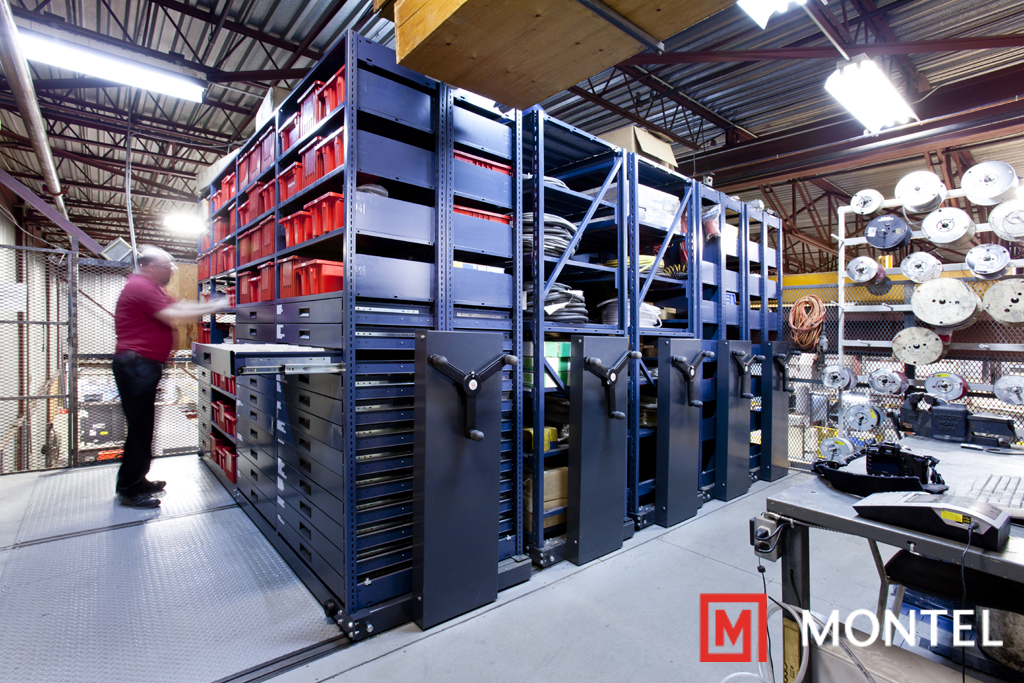
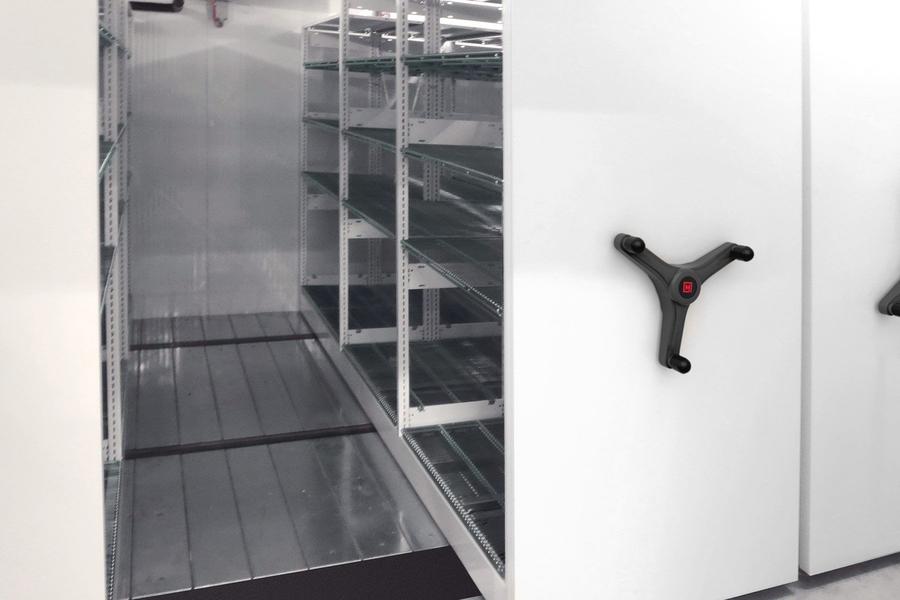
While AI provides the digital brain, Montel provides the physical infrastructure to realize these goals. Our high-density mobile racking systems are designed to tackle the single largest culprit of warehouse inefficiency: wasted, static aisle space.
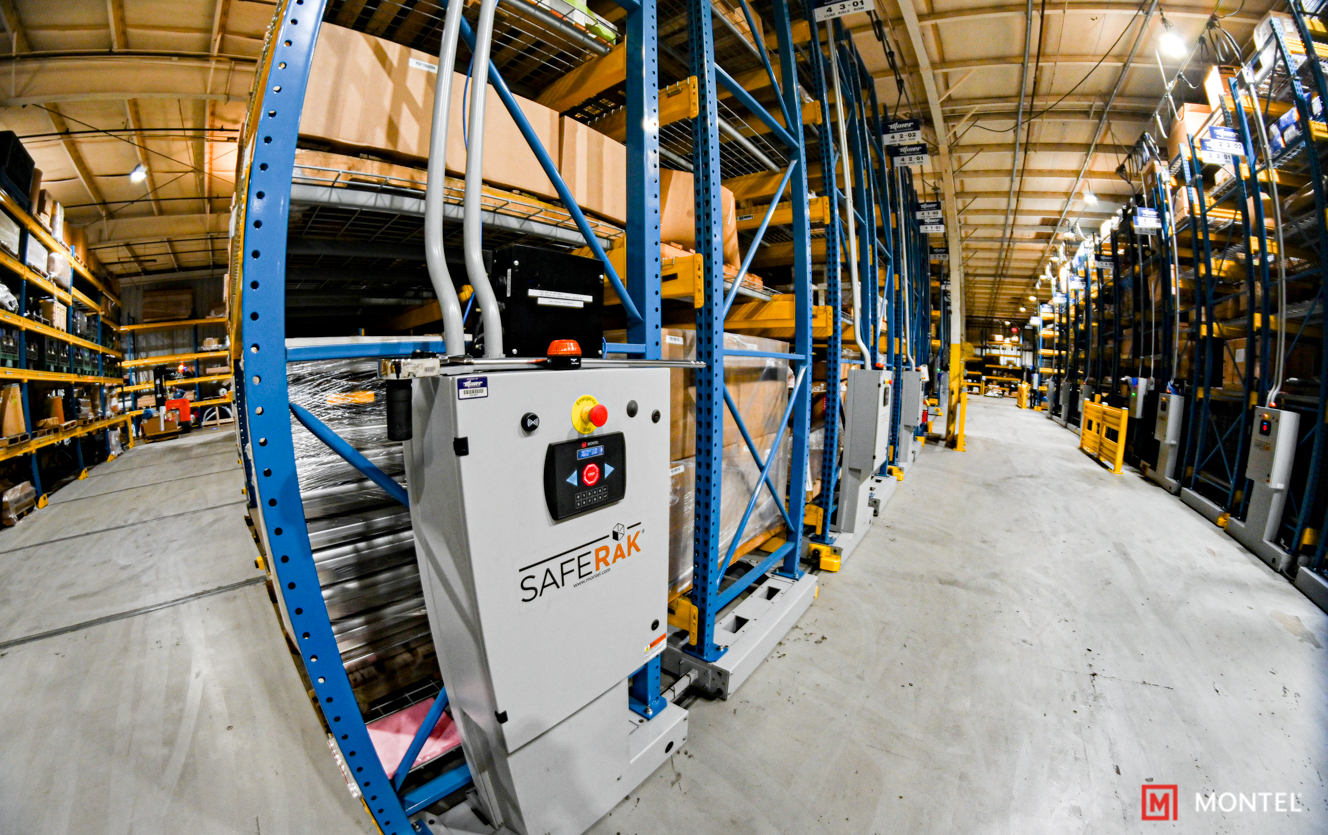
Montel’s mobile storage solutions, such as the SAFERAK® systems, eliminate the need for fixed, non-productive aisles. This physical density is the essential foundation that allows businesses to leverage the full capacity of advanced AI warehouse optimization.
Key Benefits of the AI-Structure Synergy:
- Drastically Reduce Footprint and Energy Demand: By doubling storage capacity within the same square footage, you reduce the cubic volume that requires lighting, heating, and cooling. This translates to massive energy savings and a lower utility burden.
- Avoid Resource-Intensive Expansion: Instead of constructing new buildings—which requires vast materials—our systems allow growth within current confines. This is central to smart green logistics by optimizing space and reducing energy costs.
Streamlined Operations: High-density organization facilitates faster access to inventory. This reduces the run times for material handling equipment, further decreasing associated energy use.
A Sustainable Collective Future
The powerful synergy between predictive AI and physical high-density mobile racking is paving the way for a new era of sustainability through smart warehousing. At Montel, we are proud to be at the forefront of this global transformation, helping clients boost profitability while making a genuine contribution to environmental health.
Embracing smart warehousing is no longer just a good business decision; it is a vital imperative for a sustainable future.
Ready to Transform Your Operations?
Discover how Montel's high-density mobile racking solutions can immediately cut your energy waste and prepare your facility for advanced AI warehouse optimization. Contact us today to request a consultation and learn how to build a greener, more profitable future.
Make your infrastructure part of the solution.
1-877-935-0236
Q&A
How does AI support sustainable warehousing?
AI enables predictive inventory management and dynamic energy control, reducing waste, spoilage, and unnecessary energy consumption.
What is green logistics?
Green logistics focuses on reducing environmental impact across the supply chain through smarter routing, energy efficiency, and waste reduction.
How does Montel reduce carbon footprint?
By eliminating static aisles and compressing storage footprints, Montel reduces the area requiring climate control—lowering energy use and associated emissions.
Where are smart warehousing solutions most relevant?
They are especially critical in energy-constrained and high-volume regions such as North America, Europe, and the Middle East.
What differentiates Montel’s approach?
Montel combines engineered high-density storage with a systems-thinking mindset—supporting sustainable growth through infrastructure, not expansion.