How Vertical Farming Prevents Cannabis Waste
Insights on vertical farming - June 11th 2026

Key Takeaways
- The Reality of Overproduction: Rigid infrastructure makes it impossible for growers to scale back or pivot quickly when consumer trends shift, forcing massive product destruction.
- Volumetric Control: High-density mobile systems deliver the same crop yield in a significantly smaller footprint, reducing facility overhead and maximizing productive growing space.
- OPEX Containment: When market demand dips, mobile systems allow operators to consolidate production into a smaller active footprint, reducing lighting and environmental control requirements.
- Future-Proof Design: Modular systems like GROWRAK™ allow facilities to scale their canopy footprint incrementally, ensuring CAPEX matches actual market absorption.
The Challenge of Excess Production Capacity
In a single calendar year, Canadian cannabis companies were forced to destroy more than 1.3 million pounds (600 million grams) of unpackaged cannabis—approximately one-sixth of the nation's total production. Subsequent reporting has shown that significant product destruction continues across the industry, underscoring the ongoing challenge of aligning production capacity with market demand.
While supply chain disruptions and shifting regulations played a minor role, the root issue runs deeper: an inability to balance rigid production capacity with fluctuating consumer demand.
The Cost of Rigid Infrastructure
The "Green Rush" incentivized cultivators to build massive footprints focused entirely on maximum volume. However, these facilities were frequently constructed with fixed benches and static floor plans.
When market preferences rapidly shifted—such as the sudden demand spike for premium, high-THC flower over low-THC biomass—these fixed operations could not adapt. Growers were locked into energy-intensive cycles for crops the market no longer wanted. In commercial cannabis, waste is rarely an execution error; it is an infrastructure error.
Calibrating Footprints with Market-Responsive Systems
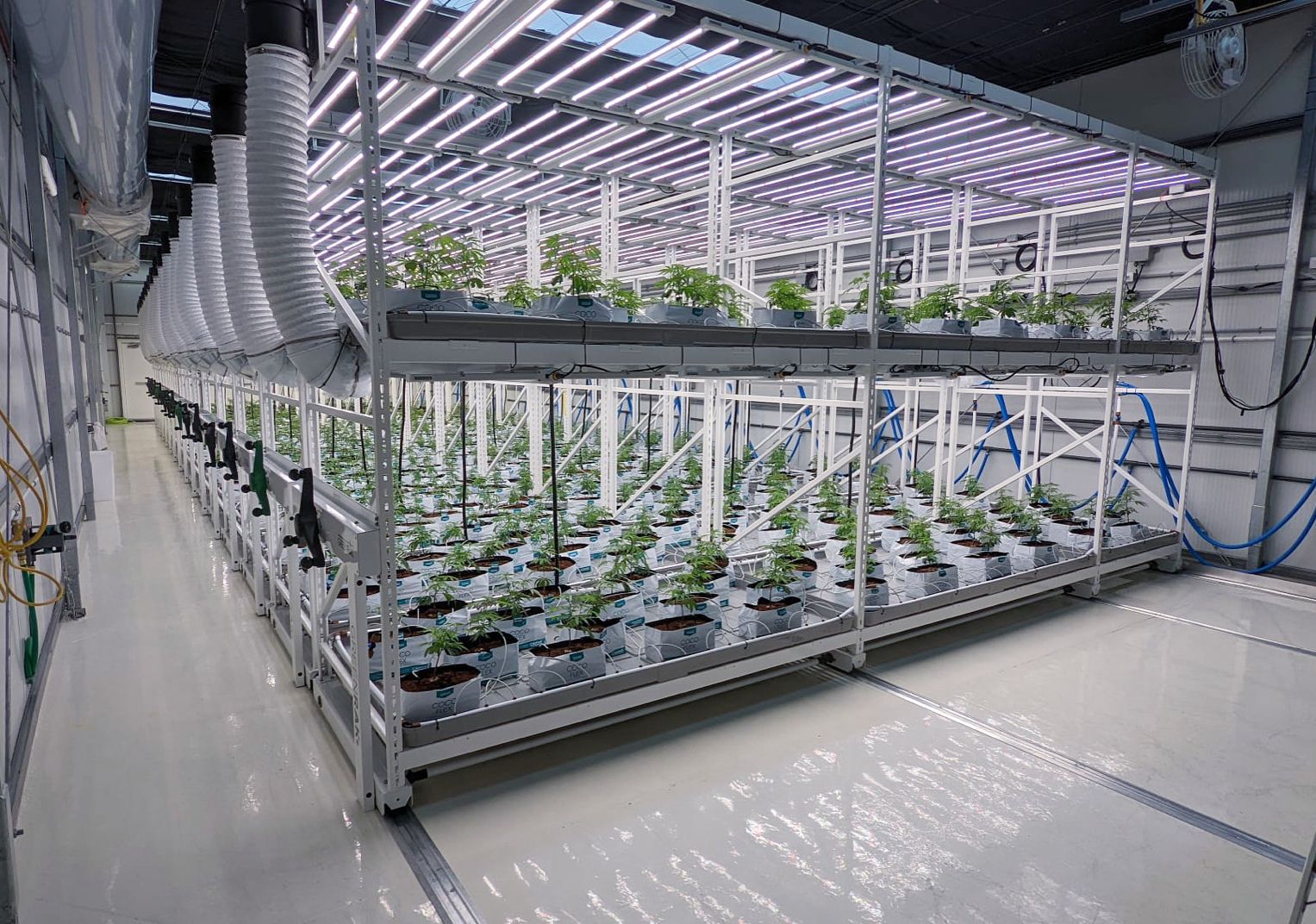
Mobile vertical farming systems are highly praised for increasing canopy volume, but their true value extends beyond yield gains. They provide the operational flexibility needed to respond to changing market conditions. A facility designed to scale its canopy footprint both up and down with precision is a facility that survives market corrections.
With Montel's custom systems, including GROWRAK™ and GROW&ROLL™, you transition from a rigid layout to a dynamic asset:
- Spatial Consolidation: Multi-tiered mobile systems compress your production footprint. If market demand drops by 30%, a Montel system allows you to consolidate your active canopy into a smaller physical zone, enabling you to reduce the amount of space that requires lighting and environmental conditioning.
- Dynamic Canopy Adjustment: Consumer tastes change. Our tool-free adjustable shelves let your team change tier heights in minutes to accommodate different cultivars, plant architectures, and production strategies as market demand evolves.
- Incremental CAPEX Scaling: You do not need to install a maximum-capacity canopy on day one. Lay your floor tracks during initial construction, then add mobile carriages and vertical tiers incrementally as your contracted sales volume expands.
Minimizing waste is about more than being environmentally conscious—it is about keeping your operation lean, organized, and structurally protected against market corrections.
Q&A: Managing Market Volatility with Mobile Racking
Q: How does a vertical system help if our facility needs to scale back production? A: In a static room, reducing your plant count means you are still lighting and cooling a massive, half-empty space. With a Montel mobile system, you can collapse the carriages together to form a tight, efficient grow zone, allowing production to be consolidated into a smaller active footprint and reducing utility OPEX associated with unused areas.
Q: Is it difficult to add more racks to a Montel system once the facility is built? A: Not at all. Montel systems are completely modular. As long as your heavy-duty floor tracks are laid during the initial build, adding new carriages or extra vertical tiers can be handled seamlessly without forcing a total facility shutdown.
Q: How do mobile systems support long-term facility growth? A: Because Montel systems are modular, growers can expand canopy capacity incrementally rather than investing in their maximum future footprint from day one. This allows capital expenditures to align more closely with production demand while preserving flexibility for future growth.