The Hidden Costs of Static Storage in Your Cold Chain Logistics
Insights on storage - April 2nd 2026
Key Takeaways
- Energy Efficiency: Reduce air volume to lower cooling demand and utility costs.
- Space Maximization: Double pallet positions without the need for new construction or expansion.
- Thermal Stability: Utilize the "ice cube effect" to maintain constant temperatures and protect product integrity.
- Operational Safety: Advanced sensors and specialized components designed specifically for sub-zero reliability.
- Future-Proofing: Align with global sustainability standards by reducing total energy consumption.
In an environment where every cubic foot of a freezer is a high-cost asset, sticking with traditional static racking is more than a missed opportunity, it’s a perpetual financial drain.
The "Freezer Tax": Why Static Racking Fails
In standard ambient warehouses, wasted space is a nuisance. In a cold room, it’s a disaster. Traditional static shelving forces you to maintain open aisles for forklifts between every single row. These aisles do nothing but hold chilled air.
Think of it as a "freezer tax." You are paying to cool thousands of cubic feet of empty space. For facilities in high-temperature regions like the Middle East, where refrigeration systems work overtime, this inefficiency can decimate profit margins. Transitioning to mobile shelving isn’t just about organization; it’s about mastering thermal economics.
The Philosophy of High-Density Solutions
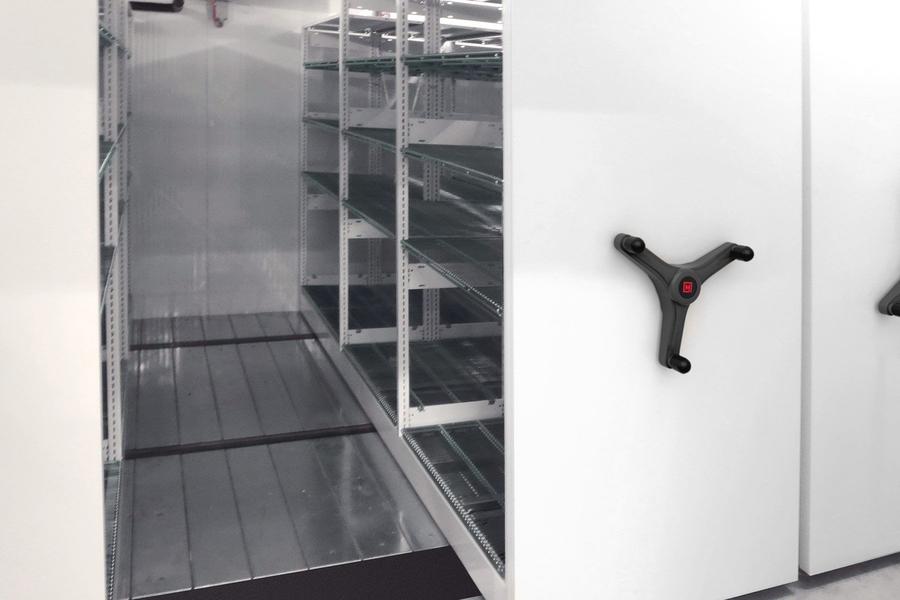
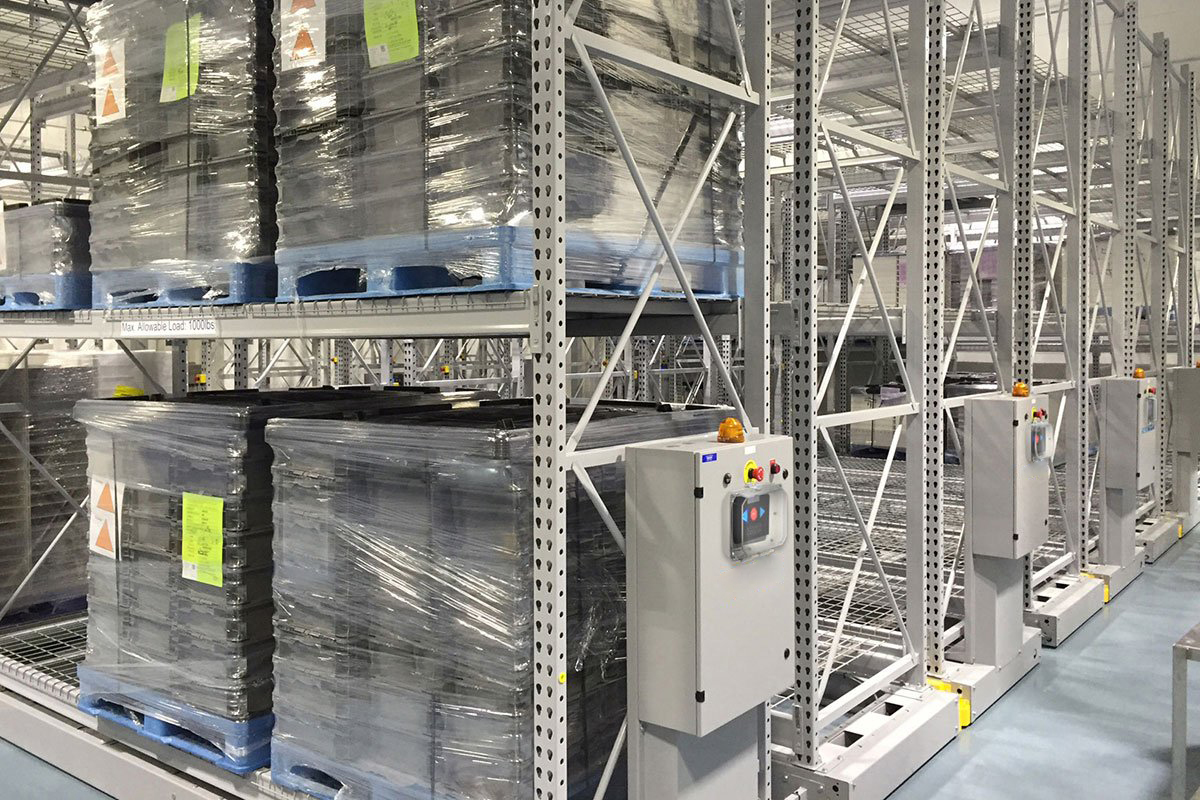
The Montel approach is simple: Grow your capacity, not your building. By mounting heavy-duty racks on high-performance mobile carriages, we eliminate fixed aisles. Instead, you create a single "floating" aisle that opens only when and where you need it.
This shift allows you to recover up to 50% of your floor space or double your storage capacity within the same footprint. For a freezer warehouse, this density is revolutionary. When you consolidate products, you reduce the total volume of air that needs to be circulated, turning a sprawling layout into a compact, efficient cold environment.
Slashing Energy Bills Through Thermal Mass
One of the most overlooked benefits of high-density storage is the "ice cube effect." A dense block of frozen product retains its temperature significantly better than scattered pallets separated by wide gaps of air.
By using mobile shelving, you create a denser thermal mass. This allows your refrigeration units to run more efficiently, cycling less frequently and reducing wear on expensive HVAC systems. In regions with high peak-energy costs, these utility savings can deliver a faster ROI.
Real Estate Optimization: Avoiding the "Cold Expansion"
Expanding a cold storage facility is often three to four times more expensive per square foot than an ambient one. Between specialized insulation, vapor barriers, and reinforced concrete, the capital expenditure is substantial.
Before you break ground on a new wing or lease more space in a crowded port city, look at your existing vertical and horizontal volume. High-density racking allows you to delay or completely avoid expensive construction. By optimizing your current layout, you turn your existing walls into a more powerful asset.
Safety and Reliability in Sub-Zero Environments
Efficiency never comes at the cost of safety. In food distribution and cold logistics, speed is vital—but so is the well-being of the team. Montel’s mechanical assist systems are engineered for the rigors of -30°C environments (Powered electrical systems are limited to -10°C), featuring specialized non-freeze lubricants and infrared safety perimeters. These systems integrate seamlessly with your existing WMS, ensuring that while storage is dense, accessibility remains lightning-fast.
Sustainability Starts with Smarter Density
Sustainability is no longer optional. As regulations in Europe and Canada tighten around carbon emissions, operators must reduce their environmental impact. By cooling less empty space and running more efficient compressors, your facility directly reduces its carbon footprint. High-density storage is, at its core, a more sustainable approach to cold logistics.
Ready to stop paying for empty air?
Don't let static racks limit your growth.
Contact a Montel expert today to request a custom-designed layout for your freezer or cold room. Let us help you double your density and slash your cooling costs.
Q&A: Optimizing Your Cold Chain
Q: Can mobile shelving really handle the weight of frozen food pallets?
A: Absolutely. Our systems are engineered to support thousands of pounds per rack, moving smoothly even under maximum load.
Q: Is it difficult to retrofit an existing freezer with mobile racking?
A: Not at all. Many of our clients have successfully retrofitted existing facilities to solve capacity issues without expansion.
Q: How does this impact "First-In, First-Out" (FIFO) logistics?
A: Because every aisle is accessible on demand, mobile shelving maintains 100% selectivity, making it perfectly suited for FIFO requirements in cold storage.