Navigating the Basics of a Cannabis Start-Up
Insights on vertical farming - June 3rd 2026

Key Takeaways
- Strategic Planning: A business plan must go beyond marketing; it must prove operational efficiency through high-density facility design.
- Regulatory Rigor: Licensing varies wildly by state; your facility's physical layout must comply with strict local tracking and security mandates.
- Financial Readiness: Scalable infrastructure like mobile racking is a "hedge" that reassures investors of your long-term profitability.
- Banking Navigation: Finding a "cannabis-friendly" bank requires vetting for operational legacy and understanding service limitations.
Phase 1: Drafting a Data-Driven Business Plan
What kind of operation are you building? If you are evaluating indoor cultivation systems, your business will likely fall into one or more of three primary sectors:
- Cultivation: The art and science of high-density growing.
- Production/Extraction: Converting biomass into high-margin packaged goods.
- Dispensary: The retail interface for the modern consumer.
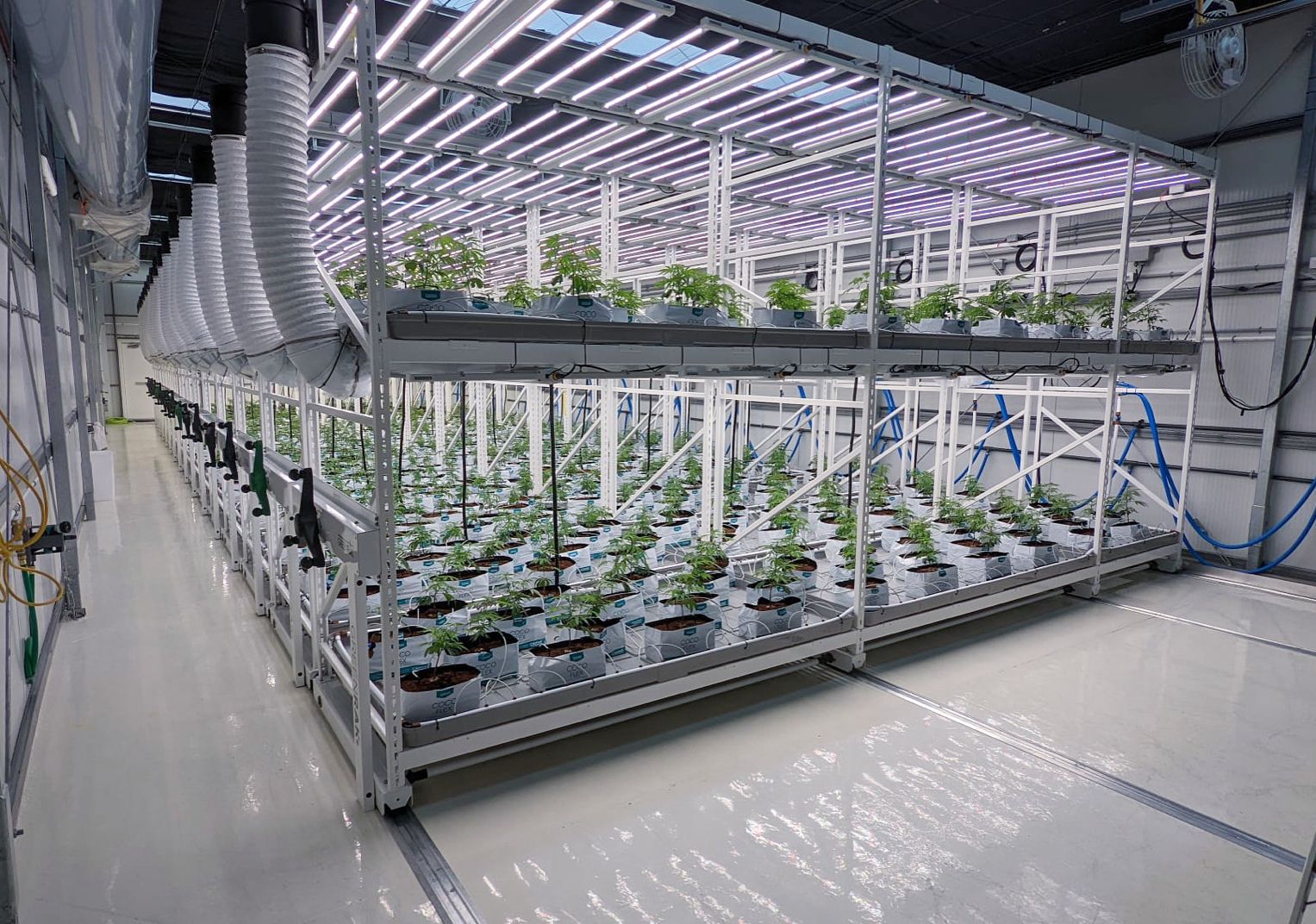
Investors aren't just evaluating your brand—they're evaluating your ability to operate efficiently and scale sustainably. Your business plan should demonstrate how your facility, processes, and infrastructure support long-term profitability. By including state-of-the-art vertical racking in your initial blueprints, you demonstrate a commitment to maximizing productive cultivation space while minimizing non-revenue-generating aisle space—a key factor in facility efficiency and ROI.
A strong business plan should answer the following questions:
- What is the core mission and competitive differentiator of your brand?
- What is the specific nature of your target state’s market?
- How will your facility layout minimize OPEX (labor, power, and water)?
- What is your organizational structure and leadership experience?
- How will you scale your production as the market matures?
- What is your projected cash flow and "break-even" timeline?
Phase 2: Registering, Licensing, and Permitting
In the United States, cannabis remains a Schedule I narcotic at the federal level, though state-level legalization has created a patchwork of opportunity. Your business specifics will revolve entirely around local laws.
Adhering to state and local regulations isn't just a legal requirement—it can also influence how your facility is designed and operated. Regulatory bodies often have strict rules regarding plant spacing, waste disposal, and security—all of which are simplified by an organized, high-density floor plan.
Phase 3: The Banking and Financing Hurdle
The disconnect between state and federal cannabis regulations continues to create challenges for businesses seeking financing and banking services. Recently, even industry giants have seen mergers evaporate due to a lack of federal reform spooking lenders. For a startup entering the cannabis market, this means your banking partner must be chosen with extreme caution.
- Learn from Existing Operators: Reach out to established operators to find "420-friendly" banks that don't openly advertise.
- Evaluate Banking Experience: Choose banks with a history of navigating the local regulatory environment to avoid sudden account closures.
- Understand Service Fees: Understand deposit limits and service fees, ensuring they fit within your tight operating budget.
Until federal banking regulations evolve to better support cannabis businesses, investors will prioritize their safety. Presenting a professional, automated, and vertically optimized facility design shows lenders that you are a low-risk, high-efficiency operator.
Phase 4: Investing in Your Infrastructure
As your business grows, the infrastructure you choose can have a lasting impact on efficiency, scalability, and operating costs. For more than 100 years, Montel has helped organizations maximize space and improve operational efficiency. Our high-density cultivation and storage solutions are designed to support growing operations today while providing the flexibility to adapt as production demands evolve.
By choosing GROWRAK™ or GROW&ROLL™ early in your journey, you ensure that your facility is built for maximum volumetric potential. This helps support future growth by allowing you to expand capacity without the need for costly facility expansions.
Ready to start planning your facility?
Q&A: Building a Scalable Cannabis Operation
Q: How does vertical farming impact my chances of getting funding? A: Investors look for "Yield per Square Foot." A facility using Montel mobile racking can produce up to 2x or 3x more product in the same footprint as static shelving, making your financial projections significantly more attractive to lenders.
Q: Do I need my facility design ready before applying for a license? A: In most states, yes. Regulators require detailed facility blueprints during the application process. Montel provides free 2D and 3D renderings to help you present a professional, compliant layout to licensing boards.
Q: Is it better to start small or go big immediately? A: The beauty of modular infrastructure is that you can do both. Start with the carriages you need today, and add more tiers or rows as your revenue grows. This "Pay-as-you-Grow" model preserves your initial capital.
Q: How do I choose between cultivation and dispensary storage? A: Both require organization, but for different reasons. Cultivation storage focuses on plant health and yield, while dispensary storage focuses on inventory security and rapid retrieval. Montel offers peerless solutions for both.